
Erasmus+  Courses KA1 •  Online Training •   Invited Expert •  KA2

Categoría: Resources in English

  • What Mindfulness Really Does to Teachers: The Science Behind the PINEP Programme

    What Mindfulness Really Does to Teachers: The Science Behind the PINEP Programme

    Research · Mindfulness · Emotional Intelligence · Education

    What Mindfulness Really Does to Teachers: The Science Behind the PINEP Programme

    A study with 180 teachers from Málaga reveals statistically significant improvements across emotional intelligence, life satisfaction, and wellbeing — after just 8 weeks.

    We talk a great deal about teacher wellbeing. But what does the evidence actually say? What happens , measurably, statistically, when teachers practise Mindfulness in a structured, emotionally intelligent way over a sustained period of time?

    This research poster, presented at the II Congress of Mindfulness in Education in Zaragoza (2019), answers exactly that question. The study was conducted by Lawrence Body alongside researchers Natalio Ramos, Olivia Recondo, and Óscar Jiménez from the University of Málaga — and the results speak for themselves.

    Mindfulness, when integrated with emotional intelligence training, doesn’t just improve how teachers feel — it changes how they teach, how they relate, and how they lead in the classroom.
    — Conclusion, PINEP Research Study, University of Málaga

    What is PINEP?

    The Programa de Inteligencia Emocional Plena (PINEP) (Full Emotional Intelligence Programme) was developed by Ramos, Recondo and Enríquez (2012). It combines foundational Mindfulness training with structured emotional intelligence development, creating a flexible and open framework that can be adapted to different educational and professional contexts.

    Unlike purely contemplative approaches, PINEP is designed to bring participants into direct, compassionate contact with their own emotional experience, both positive and negative, building autonomy in decision/making and moving beyond automatic, conditioned responses.

    How the study was conducted

    The study followed a pre-post design with a control group, evaluating participants before and after 8 weeks of PINEP training. Teachers came from across the province of Málaga, recruited through the Teacher Training Centres of Málaga and Marbella-Coín. The sample was 80% women and 20% men, aged between 25 and 65, spanning primary, secondary, vocational, and guidance education.

    Participants

    • 80% women, 20% men
    • Ages 25–65 (avg. 41–50)
    • 70% over 10 years’ experience
    • 44% primary education
    • 37% secondary & sixth form
    • 13% guidance & pedagogy
    • 6% vocational training

    Instruments used

    • Wong & Law EI Scale (2002)
    • Satisfaction With Life Scale (Diener et al., 1985)
    • Self-Other Four Immeasurables (Kraus & Sears, 2009)
    • Emociones Plenas (Ramos & Recondo, 2014)

    What changed — and how significantly

    The experimental group — those who completed the PINEP programme — showed statistically significant improvements across 11 different variables, while the control group showed no meaningful changes. Here is what improved:

    Statistically significant improvements in the experimental group

    • Intrapersonal perception  • Interpersonal perception  • Emotional assimilation

    • Emotional regulation  • Total emotional intelligence  • Life satisfaction

    • Psychophysical health  • Positive personal relationships  • Mindfulness changes

    • Changes in the classroom  • Changes in the teacher

    Among the most striking results: Emotional Regulation showed a t-value of 6.9 (p<0.001), Life Satisfaction reached 6.4 (p<0.001), and Mindfulness changes scored 7.2 (p<0.001) — all highly significant results, pointing to real, measurable transformation in how teachers experience and manage their inner world.

    What this means for education

    These findings matter beyond the statistics. When a teacher improves their emotional regulation, their students feel it. When they develop greater intrapersonal awareness, the classroom culture shifts. When their life satisfaction increases, their vocation becomes sustainable.

    The study confirms what many educators already sense intuitively: that Mindfulness and Emotional Intelligence are not extras — they are foundations. And when delivered through a structured, evidence-based programme like PINEP, the results are not just felt — they can be measured.

    Download the research poster

    We are making this research poster freely available to anyone who wants to explore the evidence, share it with colleagues, or use it as a starting point for conversations about wellbeing in their own institution. It presents the full study — objectives, methodology, results, and conclusions — in a clear and accessible format.

    Download the Research Poster — the full PINEP study on Mindfulness, Emotional Intelligence, and teacher wellbeing. Free to download and share.

    Download the free research poster →

  • When Wellbeing and Language Learning Meet: A Free Resource for Educators

    When Wellbeing and Language Learning Meet: A Free Resource for Educators

    Resources · Mindfulness · Education · Languages

    When Wellbeing and Language Learning Meet: A Free Resource for Educators

    What happens when Mindfulness, Emotional Intelligence, and English come together in the same classroom? Something extraordinary.

    At Laurus, we believe that the most powerful learning happens when the whole person is present — not just the intellect. That’s the idea behind a pioneering programme we developed for teaching staff at the University of Málaga (UMA): an integrated experience that brings together English language learning, Mindfulness practice, and Emotional Intelligence under one roof.

    The results have been remarkable. And today, we want to share them with you — completely free.

    “A course applicable to improvement and growth at different levels: personal, in relationships with colleagues, and in improving teaching practice.”
    — Programme participant, University of Málaga

    What is this experience?

    The programme was designed to respond to a growing need in higher education: how to support the wellbeing of teaching staff while also strengthening bilingual communication skills. Participants attend weekly two-hour sessions over 12, 15, or 25 weeks, depending on the format they choose.

    Using CLIL methodology (Content and Language Integrated Learning) and the theory of Multiple Intelligences, each session weaves English language practice with Mindfulness exercises, meditation, reflective journaling, and interpersonal dynamics. Everything is designed so that what is learned in the classroom can be transferred directly into professional and personal life.

    What do participants walk away with?

    Each person leaves with a personalised Mindfulness project — a concrete plan for how they will integrate these practices into their own teaching context. Many have gone on to pioneer Mindfulness initiatives within their faculties and departments.

    The programme consistently reaches near-full satisfaction scores. Wellbeing, professional application of skills, and meeting expectations all scored above 3.6 out of 4. There is regularly a waiting list to join.

    Why are we sharing this?

    Because we believe that good ideas should travel. This resource — presented as a poster at the II Congress of Mindfulness in Education in Zaragoza — summarises the full experience: its objectives, methodology, results, and conclusions. It’s a compact but complete window into what regenerative, holistic education can look like in practice.

    Whether you are a teacher, an educational leader, a trainer, or simply someone curious about integrating wellbeing into learning environments, this poster offers both inspiration and a practical framework.

    Your free download is waiting

    No course to sign up to. No prerequisites. Just a beautifully condensed resource that might spark your next idea, your next conversation, or your next project.

    Download the Experience Poster — a free resource summarising this pioneering programme in Mindfulness, English, and Emotional Intelligence for educators.

    Download the free poster →

  • When Weight Becomes Presence: A Holy Week Experience

    When Weight Becomes Presence: A Holy Week Experience

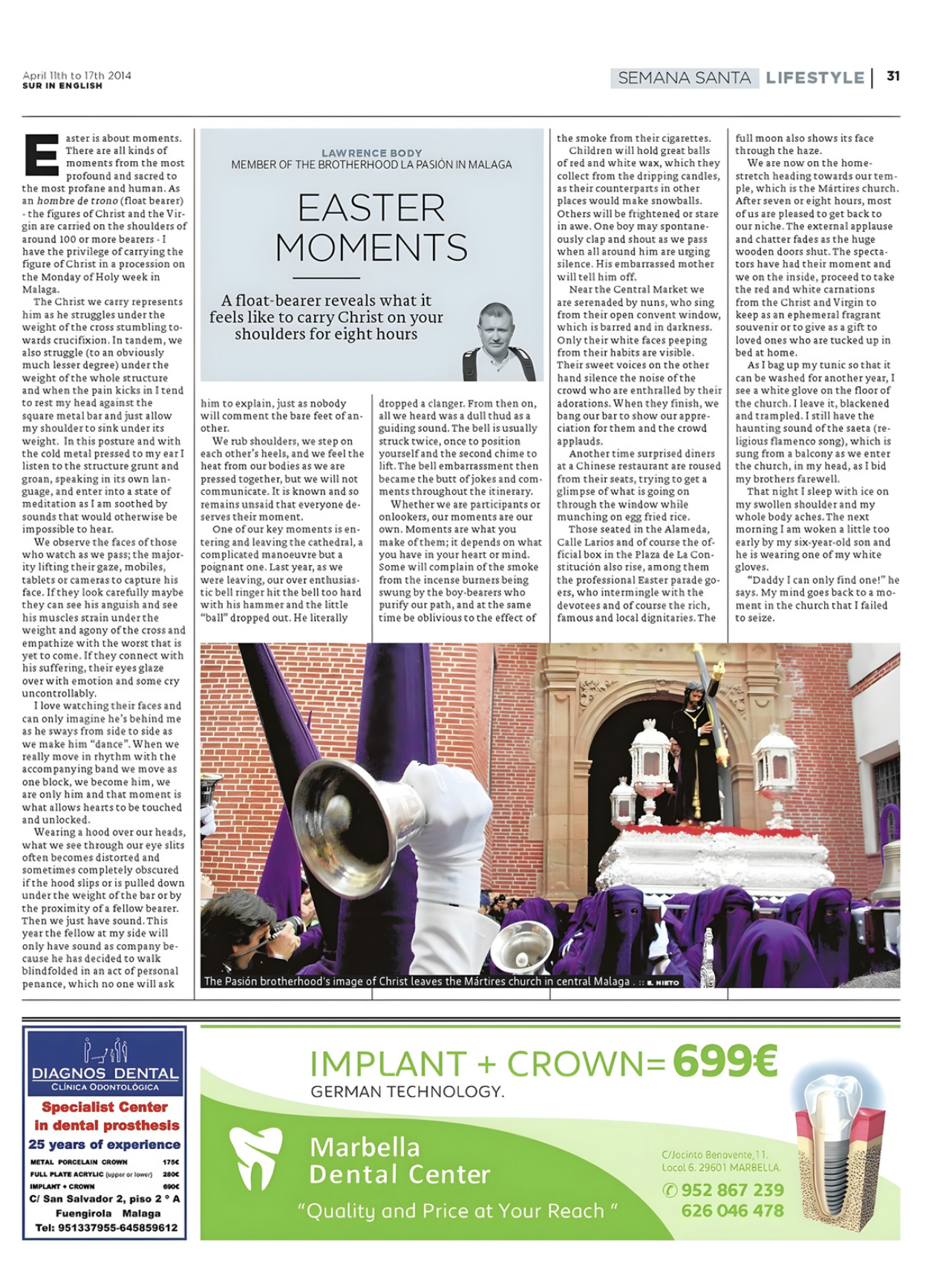
    In this article, I share an experience that deeply shaped the way I understand Holy Week. For hours, I carried the image of Christ on my shoulders through the streets of Málaga, feeling not only the physical weight, but also the silence, the emotion, and the connection with those walking beside me. It was a moment that allowed me to observe suffering, faith, and presence from a deeply personal and human place.

    More than a tradition, for me it became an opportunity to live the experience with awareness.

    If this resonates with you, I invite you to take a moment to go deeper into the experience.

  • Regenerative Organizations: A Nature-Inspired Model

    Regenerative Organizations: A Nature-Inspired Model

    Un Modelo Inspirado en la Naturaleza

    En Laurus creemos que las organizaciones regenerativas son, ante todo, organizaciones generosas, guiadas por un propósito claro y transformador: generar bienestar, promover un mundo más justo para todas las personas y cuidar de nuestro planeta. Nuestra misión es contribuir a la creación de una sociedad más compasiva y sabia. Para lograrlo, nos inspiramos en la naturaleza y adoptamos una mirada sistémica que abarca el trabajo, la educación, las comunidades y los hogares. Colaboramos con empresas, centros educativos, entidades sociales y personas individuales para dar vida a una auténtica ReGeneración.

    Nuestros programas de formación, coaching y consultoría se fundamentan en un enfoque consciente y emocionalmente inteligente, donde la autoconciencia, la autogestión, la motivación, la conciencia social y las habilidades relacionales se convierten en pilares fundamentales del desarrollo personal y colectivo

    Una Filosofía Basada en los Ciclos Naturales

    Guiados por los principios de la naturaleza, reconocemos el valor del tiempo cíclico sobre el tiempo lineal. Esta visión está representada en nuestro logotipo —la espiral céltica— y se traduce en nuestra metodología, inspirada en la medicina tradicional hindú (ayurveda y yoga) y la ciencia de los elementos naturales. Cada uno de estos elementos se vincula a un principio clave de la regeneración y a un aspecto esencial de nuestra práctica.

    🔥 PROPÓSITO | FUEGO

    El fuego representa la chispa creativa que impulsa la transformación: imaginación, intuición, inspiración e inteligencia se combinan para activar la visión regenerativa. Nuestros servicios están diseñados para acompañar a personas y organizaciones en la definición y realización de su propósito vital o corporativo, a través de un enfoque sistémico y transformador que activa el pensamiento crítico y la acción consciente.

    💧 PERSONAS | AGUA

    Las personas son el corazón de cualquier sistema. Al igual que el agua, que da vida, sabor y fluidez, la conexión humana aporta sentido a nuestras acciones. Valoramos profundamente las relaciones, la comunicación empática y la construcción de entornos donde florezcan la gratitud, la compasión y el bienestar emocional. Fomentamos la inteligencia emocional como herramienta para mejorar las relaciones, cultivar la felicidad y reforzar la cohesión social.

    🌍 PLANETA | TIERRA

    El planeta es nuestro hogar común, y su bienestar es inseparable del nuestro. En Laurus promovemos una visión que va más allá de la sostenibilidad: trabajamos por la regeneración, entendida como la capacidad de devolver a la naturaleza parte de lo que nos ofrece. Nos inspiramos en el laurel (Laurus nobilis), símbolo de conexión con la sabiduría natural. Nuestra oferta incluye baños de bosque, retiros en la naturaleza, ecología aplicada y viajes conscientes, como herramientas regenerativas para individuos, organizaciones y comunidades.

    🌬️ SOCIOS | AIRE

    El aire simboliza el aliento vital y la colaboración. En Laurus creemos en el poder de las redes, las alianzas y el trabajo conjunto como motor de transformación. Ya colaboramos con entidades en España, Irlanda, Francia, Turquía, Hungría y Reino Unido, especialmente a través de programas como ERASMUS+, que impulsa el intercambio pedagógico y la cooperación internacional. Además, nuestra sede en el Impact Hub Málaga nos permite formar parte de una comunidad global de emprendimiento con propósito.

    🌌 LUGAR | ÉTER

    El éter es el espacio que lo contiene todo. Representa la consciencia universal, el escenario donde convergen propósito, personas, planeta y colaboraciones. En este espacio nace la verdadera creatividad regenerativa, inspirada por la escucha profunda del entorno y del corazón. El símbolo del pentáculo —y su relación con el número 5 de la secuencia Fibonacci— nos recuerda que todos los frutos nacen de flores de cinco pétalos que contienen en su interior las semillas de la regeneración.

    En Laurus, aspiramos a acompañar procesos de transformación con raíces profundas y visión elevada, cultivando organizaciones vivas, sostenibles y regenerativas, al servicio del bienestar común y del equilibrio planetario.

  • Mindfulness and Education

    Mindfulness and Education

    Editor: José Emilio Palomero Pescador

    Monografía coordinada por Pablo Palomero Fernández


    RIFOP. Año 30. Con el presente número (30.3. Diciembre 2016), en el que publicamos una monografía sobre mindfulness y educación, la Revista Interuniversitaria de Formación del Profesorado (RIFOP) cumple su trigésimo aniversario. Por ello comenzaremos este editorial haciendo un breve recorrido por su historia.

    En la página 47 se puede leer los resultados de nuestra investigación sobre formación de mindfullness para el profesorado del CEP de Málaga.